
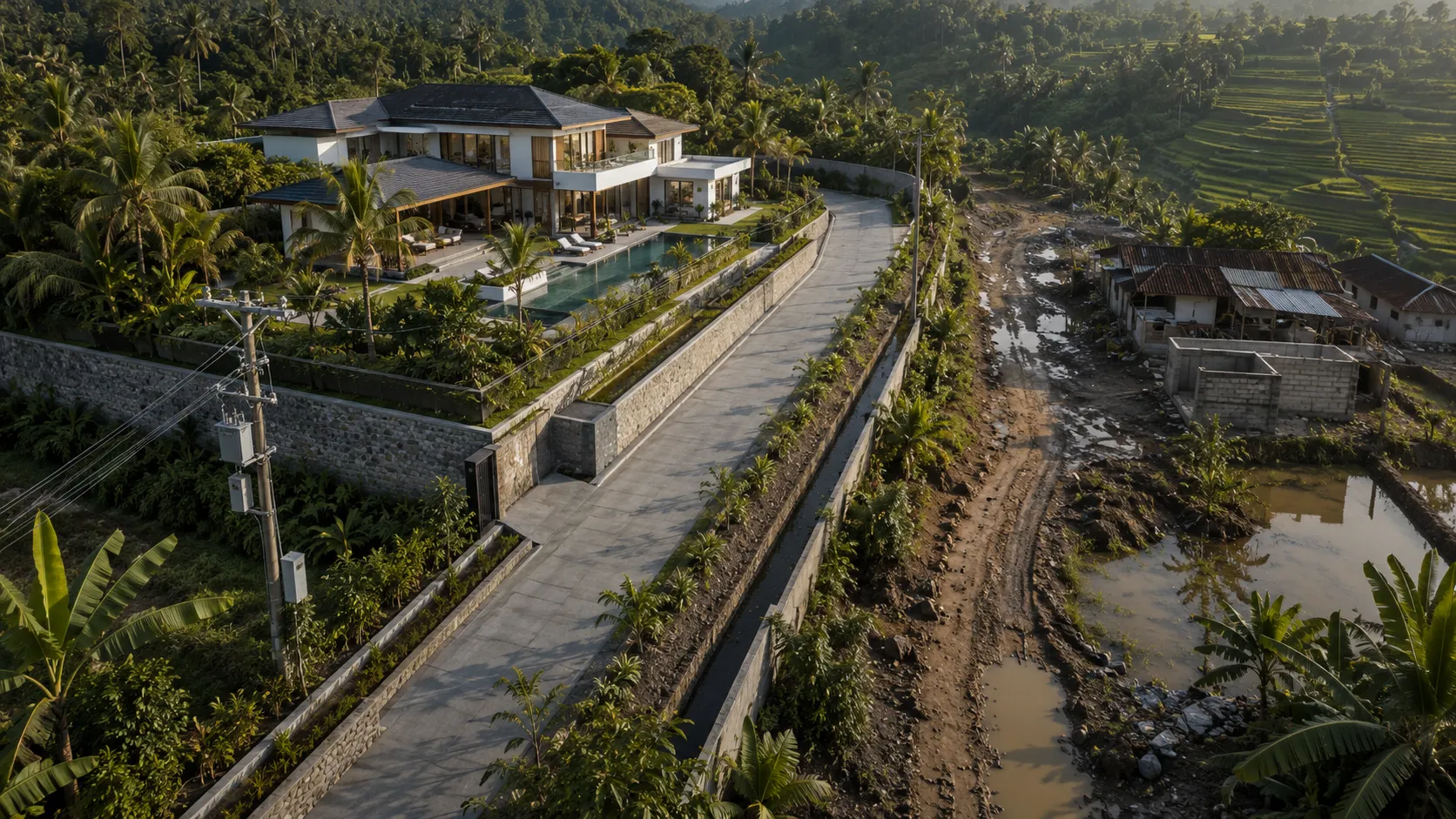
Infrastructure and access: the hidden factor that makes or breaks a villa
In Bali, even the most beautiful plot can become a nightmare if the infrastructure doesn’t support the project.
This guide explains the essentials:
- road access
- electricity capacity
- water supply
- banjar agreements
- future development plans
- drainage and rainy season realities
Why this matters in Bali
Unlike some countries, infrastructure in Bali is not standardized. Two neighboring plots can have completely different realities:
- One has a paved road, the other has an unmaintained dirt track.
- One has strong PLN electricity, the other shares power with three villas.
- One has clean water through a deep well, the other has salty groundwater.
These differences affect:
- build cost
- timeline
- maintenance
- rental operations
- resale value
- whether the villa is even comfortable to live in
What can go wrong
- Trucks can’t reach your land (yes, it happens).
- You rely on temporary electricity lines that fail.
- Your well produces brackish or contaminated water.
- Drainage floods the land during rainy season.
- Access road disputes with neighbors or banjar.
- Sudden construction nearby blocks your view or makes noise unbearable.
How Santiago handles this
Santiago checks infrastructure as seriously as he checks legal structure.
He always:
- assesses actual road width and truck access
- checks electricity capacity with PLN
- verifies water sources and feasibility of drilling
- talks directly with neighbors and banjar
- evaluates long-term access agreements
- checks future development signals
He explains true long-term operational impact, not just what looks good today.
What you should watch for
Ask:
- “How do trucks get here?”
- “What is the electricity capacity?”
- “Where does the water come from?”
- “What happens in rainy season?”
- “Any plans for nearby development?”
If nobody brings these up, it’s a red flag.